
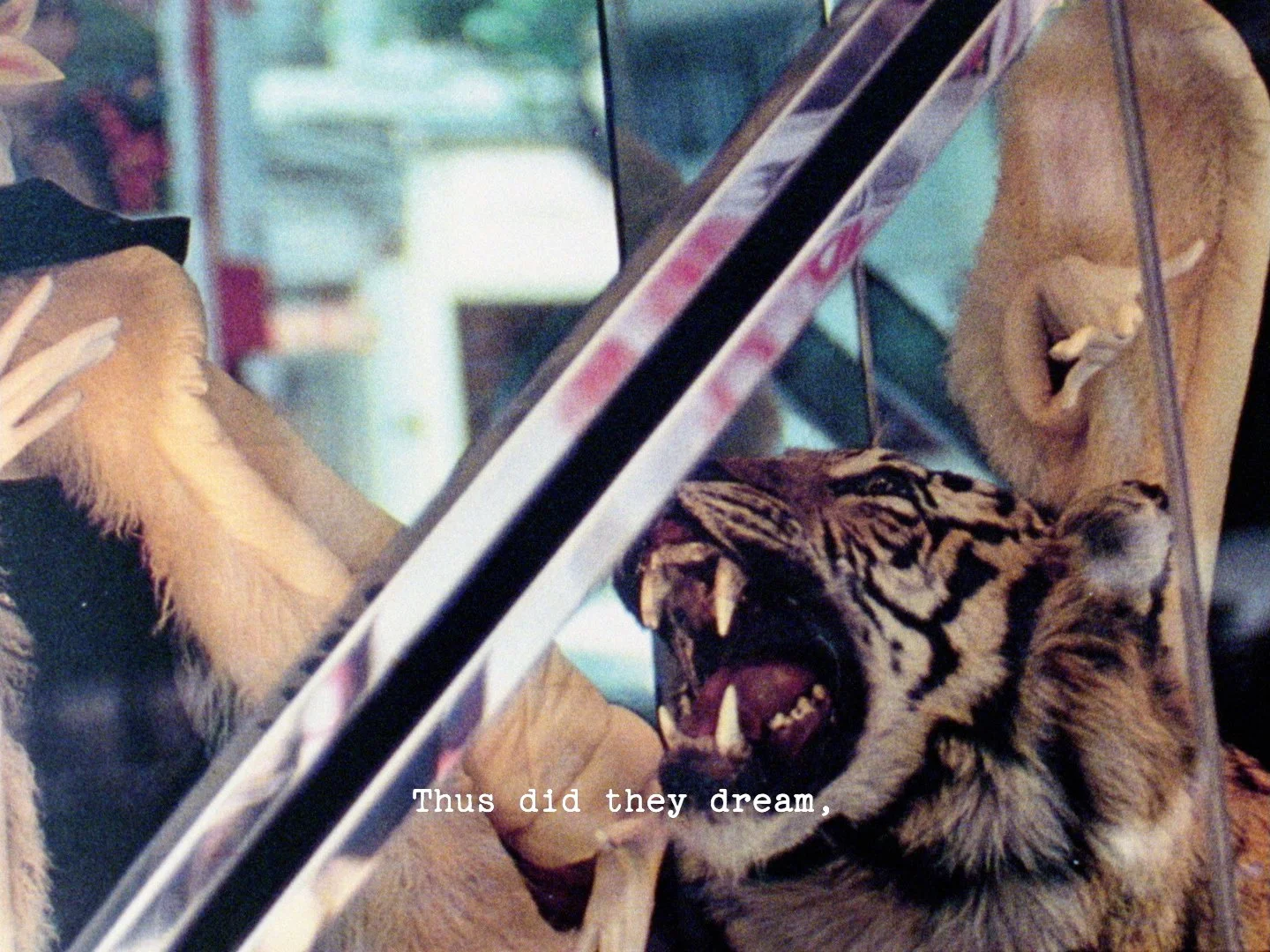
Lyrical flights, sumptuous images and dazzling, almost inexplicable beauties: In Correspondence with Journey to the Sun (part one: They Were in Wait Only of a Miracle)
Duncan White
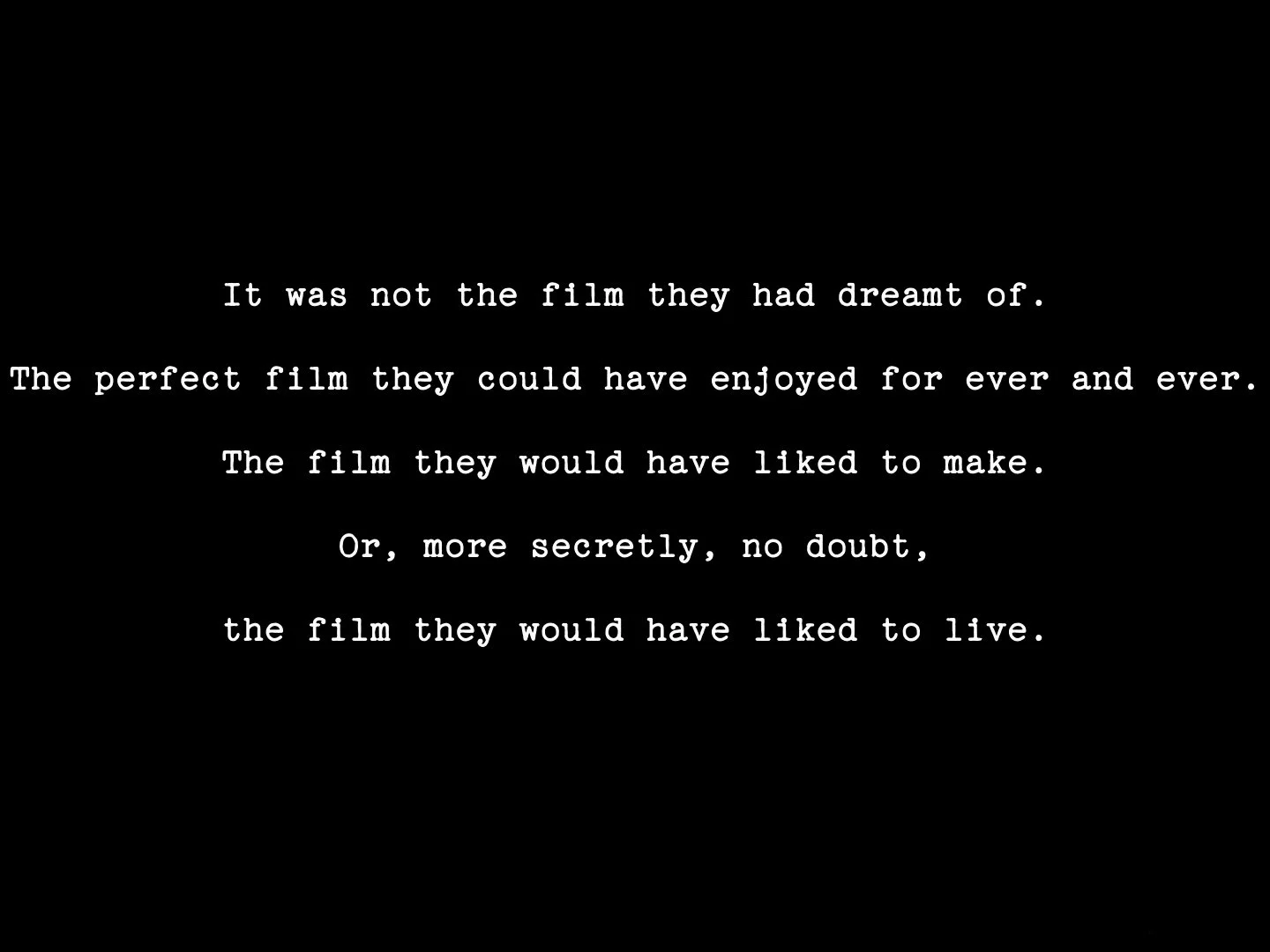
Editor’s note: in this essay, Duncan White follows Graham Ellard and Stephen Johnstone's recent art film Journey to the Sun. Part one: They Were in Wait Only of a Miracle (2025), as it drifts through a mix of found and newly made footage, pages of aspirational art magazines and Georges Perec's 1966 novel Things: A Story of the Sixties. Shot in 16mm, the film conjures a phantasmagorical portrait of Paris inhabited by the fictional bourgeois-bohemian couple Sylvie and Jérôme, a portrait in which street views, shop windows and precisely arranged interiors shimmer with promise and consumer longing.It was not the film they had dreamt of. The perfect film they could have enjoyed for ever and ever. The film they would have liked to make. Or, more secretly, no doubt, the film they would have liked to live.(1)
You would see a plastic-mounted 35mm slide.(2) On the slide you would see a picture of a young man and woman sitting side-by-side in an audience. The slide is titled Jerome/Sylvie.(3)
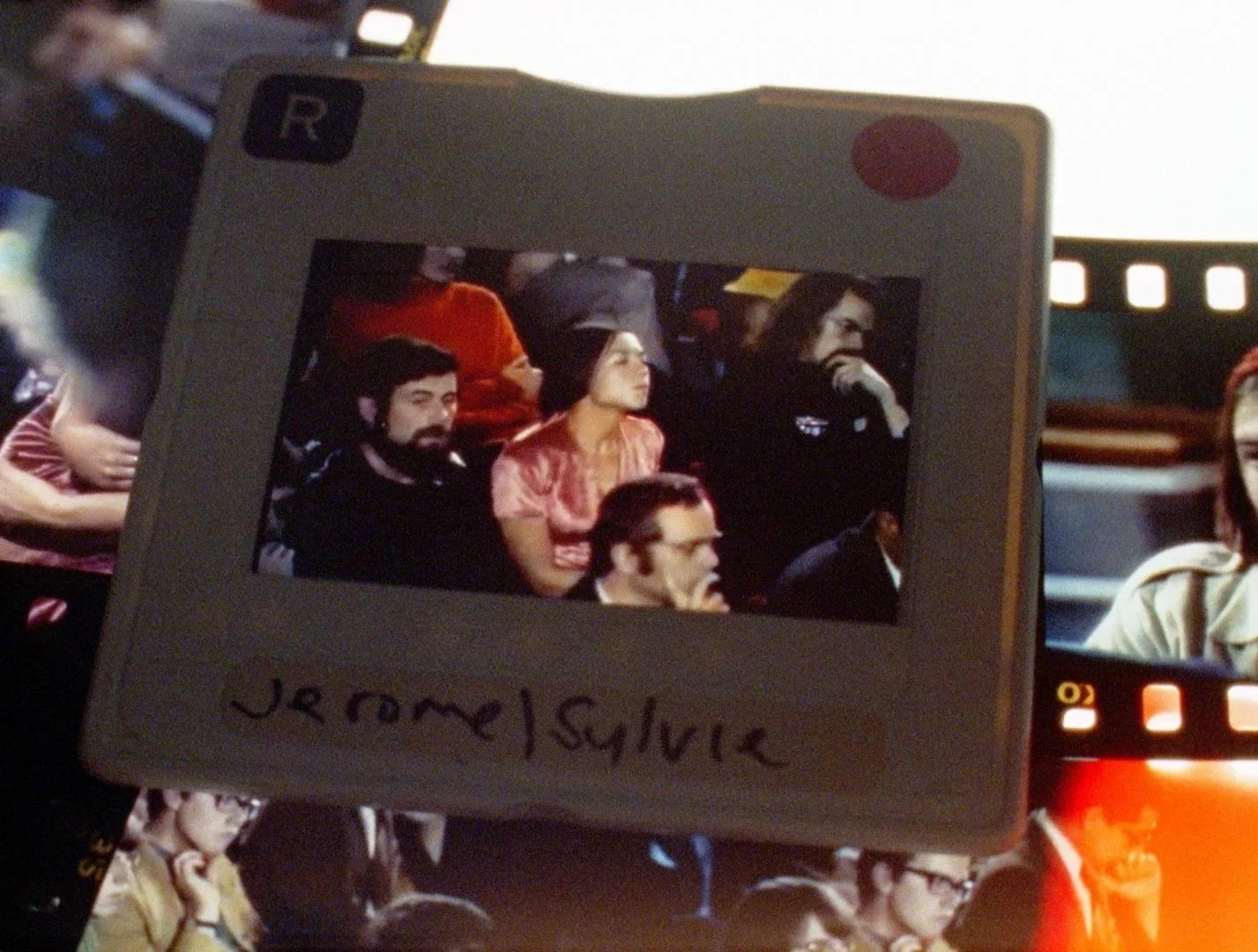
Beneath the slide you would see cuttings of film strips, the surface of a light box. Sylvie is looking forward. Jerome is looking off to the side. You would see mannequins in a window dressed in red. You would see antique furniture. You would see the fashions of the day. You would see fashion displayed in windows, in magazine pages, on the surfaces of things. You would see fashion reproduced.(4) You would see Paris at night in 1970.(5) You would see Jerome and Sylvie again, in the audience, this time in reverse. Instead of in a picture on a slide, they fill the screen. You would see them moving for a second or two. You would see Jerome’s knitted cardigan, his bohemian beard. You would see Sylvie’s silk shirt, her hair loosely tied. You would see moments of darkness, then brightly lit spaces, interiors and exteriors. You would see a shop assistant in a blue neck-scarf.(6) You would see saturated colour. Every hue. You would hear the ambient waves of electronic synthesisers and the voice of Michel Foucault. You would read: They would cross all of Paris to see an armchair they’d been told was just perfect. (7) You would read the line again, repeated, or half repeated, and you would see a soft paste porcelain figurine
You would see perfume bottles of Yves Saint Laurent, antique silverware, jewellery by Christian Dior, crystal chandeliers. You would see the brochures of exquisite auction houses such as Etude Couturier Nicolay. You would read: Sometimes it would seem to them that a whole life could be led harmoniously amongst these objects so perfectly domesticated, that they would have ended up believing that these bright soft simple and beautiful things had only ever been made for their sole use. But they wouldn’t feel enslaved by them. You would see a beautiful romantic young French couple walking along a street.(8) You would see the couple holding hands, laughing. You would see the sunlight through their hair. You would see the fountains. You would see them admiring print reproductions of paintings by Toulouse-Lautrec. You would see surfaces, appearances, the image and its appearance taken out of time and space.(9) You would see a transformed world. You would see a recording of an audience. You would see an audience watching and listening, waiting for something to happen. You would see yourself.
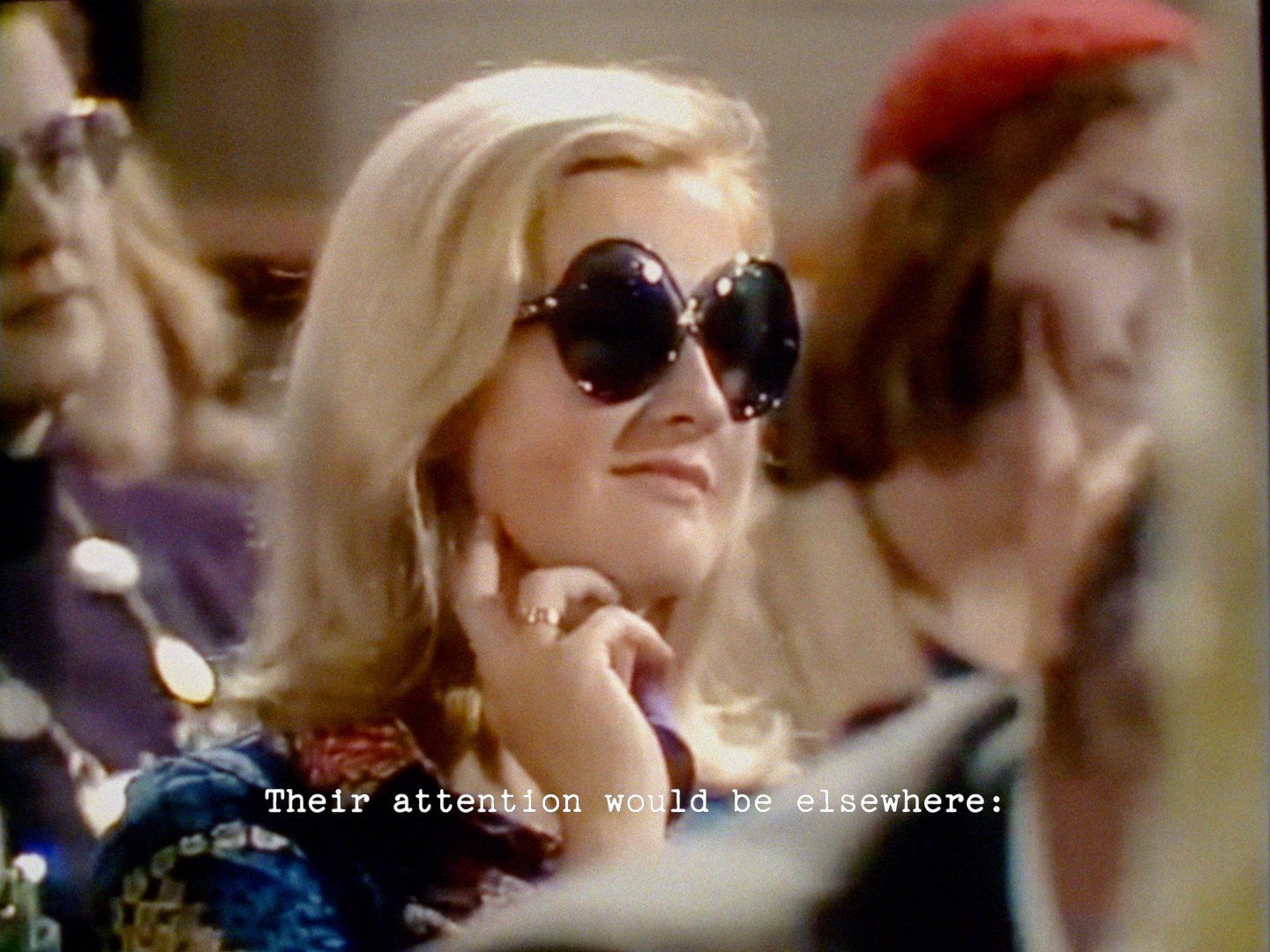
You would see signs and symbols.(10) You would see signs and symbols repeated.(11) You would see Paris at night in 1970, again. You would see the likeness of two people known as Sylvie and Jerome, again. You would see an audience listening to Noam Chomsky and Michel Foucault, once more. You would see young people wearing stylish clothes, fashionably turned out, once again. You would see highly tailored onlookers, haute couture, fitted suits, carefully crafted facial hair. You would see a pair of high-heeled shoes. You would read: They would have liked to be rich. You would see people listening, waiting, hoping to learn. Hoping to be seen. You would read: They would have liked to be rich. You would see a chandelier again. A soft paste porcelain figurine, again. You would see the dreams repeated. You would see the dreams reproduced. You would see two people in an audience who are not Sylvie and Jerome.(12)
(1) The epigraph I open with is taken from the second opening title of Graham Ellard and Stephen Johnstone's 2025 film Journey to the Sun (Part one: They Were in Wait Only of a Miracle). This, in turn, is a quotation from Georges Perec's novel Things: A Story of the Sixties. It was also used in Jean Luc Godard’s film Masculine and Feminine (1966), which is audible on the soundtrack during the opening frames of Journey to the Sun. Godard never credited Perec.
(2) The slide appears in Journey to the Sun's opening shots. The film is shot on 16mm and is largely assembled from commercial photographs and archival footage filmed using a ‘reverse telecine’ system in the artists’ studio.
(3) Jérôme and Sylvie are the main characters in Perec’s Things, first published in French in 1965, and later in English in 1990. The novel documents the lives of the young couple who are obsessed with material things. As David Bellos notes: 'Things aims to exhaust all that can be said about fascination, and, more particularly to explore what words like happiness and freedom can mean in the modern world – the world of consumerism as it was emerging in the France of de Gaulle.' In Ellard and Johnstone’s richly coloured film, accompanied by a hypnotic electronic soundtrack, this exhaustive form of fascination is heightened to the point of the hallucinogenic.
(4) Perec’s novel became extremely fashionable at the time of its publication, along with Perec himself, at least within certain young intellectual circles, the same way that Roland Barthes was fashionable. Or, for that matter, Michel Foucault. 'Ideas were in fashion', Perec wrote in a fashionable newspaper column in 1966 soon after the publication and prize-winning success of Things, and 'were subject to fashion’s iron law of obsolescence – hence the need for new schools [of thought] to replace pre-used models.' (See the chapter titled 'Perec in Fashion' in David Bellos, Georges Perec:A Life in Words). It may be the case that the formal use of the conditional tense – 'They would see themselves…' etc – that governs Perec’s novel and that I mirror here, derives in part from the language of fashion and desire. It is aspirational, but also, as Chris Kraus points out in her book Torpor, it is 'a tense of longing and regret, in which every step you take becomes delayed, revised, held back a little bit. The past and future are hypothesised, an ideal world existing in the shadow of an if. It would have been.'
(5) Ellard and Johnstone took temporally specific shots of this kind from the archive of Doug Jones, International Travel Films – a collection of Jones's travelogues shot around the world on Super-8, 35mm and 16mm film.
(6) The end credits for Journey to the Sun, which make up the film's final seven or eight minutes, tell us that this was taken from International Travel Film item titled (for ease of use) 'Christian Dior, saleswoman shows a colourful scarf', Paris, 1970.
(7) This and all other captions in Journey to the Sun are taken directly from David Bellos’ English translation of Perec's Things.
(8) The full listing for this footage, available via Shutterstock, is: 'Beautiful romantic young French couple walking along a street'. Paris, 1970.
(9) Much of Perec’s work is concerned with disappearance. For instance, the disappearance of a boy named Gaspard Winkler in W, or Memory of a Childhood (1975) or the apparently random disappearance of characters, sometimes mid-scene, in A Void (1969) – a novel in which the letter 'E' has also been disappeared. In Things the opposite is the case. Here it is appearance, rather than disappearance, that defines the book's thrust and momentum. The oversaturated appearance of so many things is then amplified once more in the close-ups and crystalline focus of Ellard and Johnstone’s film. Interestingly, in Perec’s script for his own film adaptation of Things, the writer added several new characters, including a Gaspard Winkler who was set to be Jérôme’s best friend: 'an ultra Jérôme. . . Agoraphobic and misanthropic, Gaspard has an inimitable manner of living in absentia.' (See David Bellos, Georges Perec: A Life in Words, Harvill, London, p. 331).
(10) The nascent 'science' of semiology was in the air when Perec wrote Things in the early sixties. As he once claimed in a lecture at Warwick University, the four books that created the 'gap' for things were Gustave Flaubert’s Sentimental Education (1869), Paul Nizan’s The Consiracy (1938). Robert Antelme’s The Human Race (L’Espèce humaine, 1947) and Roland Barthes’ Mythologies (1957).
(11) Throughout Journey to the Sun, repetition is used as a key structuring device – words and phrases are repeated, as is some of the footage, perhaps in order to defamiliarize the material, to further remove it from its original source. Repetition is also used as a visual and sonic form of punctuation – a rhythm of intervals or cuts held together by seeing and reading in equal measure.
(12) Perec’s characters, Sylvie and Jérôme, have been re-purposed or re-animated elsewhere, most notably in Chris Kraus's 'auto-fictions' but also, memorably, in The Orchard: A Remembrance of Georges Perec (1988), Harry Mathews' experimental memoir written in the wake of Perec’s early death at the age of forty-five. The Orchard borrows the refrain of Perec’s own collection of memories, Je me souviens (1978), a strategy also borrowed elsewhere, including by Joe Brainard in his book I Remember (1970). The last lines of The Orchard are particularly poignant here: 'I remember Georges Perec at the end of a short outing standing somewhat out of breath amid the lengthening grass of the hillside, leaning against a plum tree, smiling contentedly as he conversed with his visitors, old friends who had travelled a long way to see him – Anton Voyl; the painter Valène; Jérôme and Sylvie, a couple he had known for many years of whom he was particularly fond'.
(13) Many of these images in Journey to the Sun are taken from Vitrines de Paris/Shop Windows of Paris/Schaufenster von Paris, a 1980 collection of photographs by Olivier Garros and Dominque Souse that document in colour the universe of Parisian window dressing during the 1970s. A number of the photographs double the displays behind the glass with reflections of the street where the photographer can sometimes be located – a practice reminiscent of Eugène Atget who photographed fin de siècle street scenes (including mannequins in shop windows) and made his work available as source material for other artists to work from, borrow, manipulate or reproduce.
(14) Perec describes this cartography of the city as an internal world outwardly expressed: 'Their paths through Paris constituted their real universe: in them lay their ambitions and their hopes… the whole of Paris was a perpetual temptation. They burned with desire to give in to it, passionately, straight away and forever.' These lines from Things are quoted in Journey to the Sun.
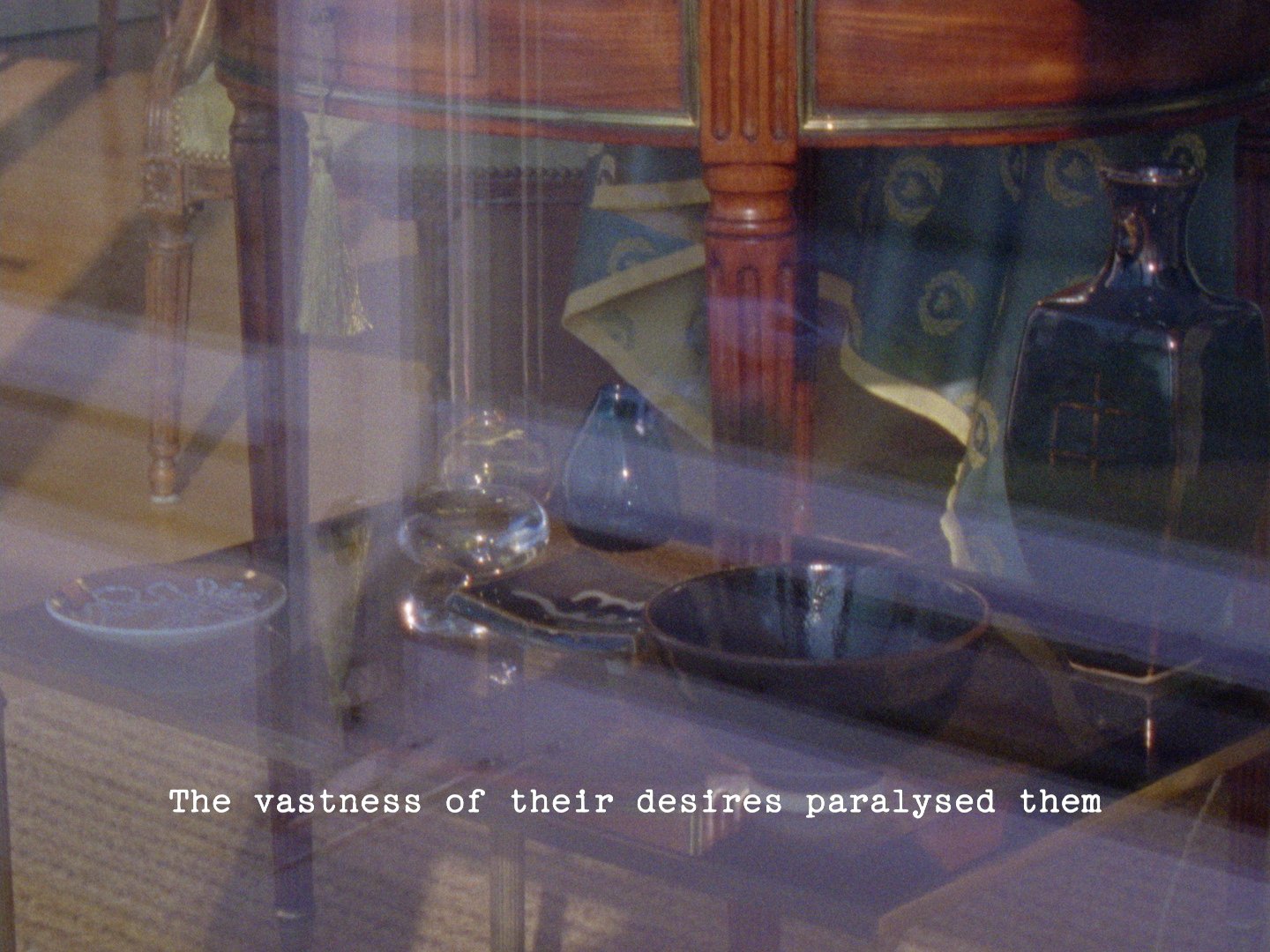
(15) The pages of Connaissance des Arts are shot in Journey to the Sun in the form of landscapes or closed-off interiors in their own right. The images housed within the format of an art magazine are not representations so much as locales – or dream locales – that can be travelled to in photographs via re-photography, like nested cabinets.
(16) This footage is described as: 'Woman rummaging through objects at a flea market in Paris', 1970.
(17) A Man Asleep, sometimes also known as The Man Who Sleeps (Un Homme Qui Dort) was a film adaptation of Perec’s book of the same title, or at times in English, The Man Who Sleeps. The film was made by Bernard Queysanne and Georges Perec. While it is a piece of fictional filmmaking it has a strong documentary-like aesthetic. Perec worked on several film projects. Those that were completed during his lifetime included: Les Lieux d’une Fugue (1978) and Ellis Island Re-visited, a two-part documentary made for French television with Robert Bober and broadcast in 1980. Much of Perec’s film work combines memory, ethnographic-like observation and the archive.
(18) See David Bellos, Georges Perec: A Life in Words.
(19) Georges Perec, Things: A Story of the Sixties, Vintage, London, 2011. Later in the same passage: 'They did not lack taste. They were highly suspicious of so-called art movies, with the result that when this term was not enough to spoil a film for them, they would find it even more beautiful (but they would say – quite rightly – that Marienbad was "all the same, just a load of crap!); they had an almost exaggerated feeling for Westerns, for thrillers, for American comedies and for those astonishing adventures full of lyrical flights, sumptuous images and dazzling, almost inexplicable, beauties such as (the titles were imprinted on their minds forever) Lola, Bhowani Junction, The Bad and the Beautiful, Written on the Wind.'
(20) On the attempted 1966 film adaption of Things: 'The writers [Perec, Jean Mailland and Raymond Bellour] persuaded the producer that dinner parties would have to be part of their preparatory work on the film, and they got an advance on their expenses from him. They then cast around among the people they knew and selected couples to carry out a real-life replay of Things. The three co-directors intended to make the adaptation and experiment in conviviality as well as an experimental film; “happenings” were all the rage at the time. They were really rather wicked, Jean Mailland concedes.' At the lavish parties in Jean-Jacques Brochier’s elegant apartment 'few of the invited guests knew why they were there. . . Not all of the guests realised that the older men who threw in comments and caustic remarks from time to time were Henri Lefebvre and Louis Althusser. Perec made notes.' (From David Bellos, Georges Perec: A Life in Words). A collaborative scenario or script was completed and submitted to a government funding body in France, but the film was never made.
(21) The young man and woman who have been unwittingly framed as Jerome and Sylvie in Journey to the Sun, or possible contenders for the role of Jerome and Sylvie, along with those around them, were (as Ellard and Johnstone stress) originally shot using the plumbicon tube system designed for the production of television broadcasts. According to a technical report published in the Journal of the Society of Motion Picture and Television Engineers, June 1964: 'The photosensitive layer of the Plumbicon is an evaporated microcrystalline layer of lead monoxide. The most significant advantages of the Plumbicon are the low dark current, the high speed of response, which is independent of light intensity, and the high sensitivity. In the Plumbicon, every picture gives a signal that is dependent solely on the light-intensity projected on that particular picture element within the proper time-limits and is unaffected by disturbing effects known from other pickup tubes. This new tube is expected to prove especially suitable for colour television.' Before it was replaced, the same oxidised tubes were used by the BBC to televise an Elton John concert a year or so later. It was used in this instance to film the famous televised debate between Noam Chomsky and Michel Foucault at Eindhoven University of Technology in 1971. We do not see the debaters in Journey to the Sun. What we see instead are cutaways to the audience, mainly made up of students, young intellectuals and other well-dressed onlookers. Graham Ellard and Stephen Johnstone have worked collaboratively since 1993. Their work revolves around the craft and skill of 16mm filmmaking and emphasises the material particularity of film - its ‘slowness’, its unique colour palette and extraordinary subtlety of tonal range. Frequently combining archive material, drawings, models and studio recreations, and typically set in highly specific locations or referring to specific (often elaborate) historical contexts, their films are resolutely visual, prioritising the image, film form, structure and affect over the didactic explanation or explicit narrative. At the centre of their work is a concern with the altered forms of attention, and the resulting intensity of looking, that comes from using a lens to frame and magnify details and capture fleeting atmospheric effects.
Since 1993 their work has been shown internationally, including group exhibitions at Centre Georges Pompidou, Paris; Tramway, Glasgow; MoMA, Sydney; Tate Liverpool; Setouchi Triennale, Japan; Stroom, Den Haag. Solo exhibitions include: The Weston Studios, The Royal Academy of Art, London; The British School at Rome Gallery, Rome; Satellite Gallery, Nagoya, Japan; Site Gallery, Sheffield; De La Warr Pavilion, Bexhill; Estorick Collection of Modern Italian Art, London. Screenings include: Anthology Film Archives, New York; Close Up Cinema, London; Image Forum, Tokyo; Guggenheim Museum, New York; London Film Festival; Rotterdam International Film Festival; Oberhausen International Film Festival; Tate Britain, London; Keio University Art Centre, Tokyo; and Kunsthalle Mainz, Germany.
Duncan White is a London-based poet, writer and Research Fellow at Central Saint Martins, where he leads the MRes Art: Moving Image pathway. He is the co-author of Expanded Cinema: Art, Performance, Film (Tate Publishing), commended in the 2012 Kraszna-Krausz Awards. In 2021 he authored the novel A Certain Slant of Light (Holland House Books), a meditation on grief blending fiction, essay writing and archival images. The novel was shortlisted for the Fitzcarraldo Editions Prize. His writing has appeared in journals including Journal of Visual Culture and Moving Image Review & Art Journal (MIRAJ). His poetry has been published in magazines and journals such as Hotel, Jacket and Blackbox Manifold. White’s other writings relating to the works of Georges Perec include, ‘O O O – Or Interviews with the Dead’ (2025) (https://malarkeybooks.com/fiction/o-o-o) and ‘A History of Dreams: Or The Experimental Cinema of Georges Perec’ in The Palgrave Handbook of Experimental Cinema edited by Kim Knowles and Jonathan Walley (2024).
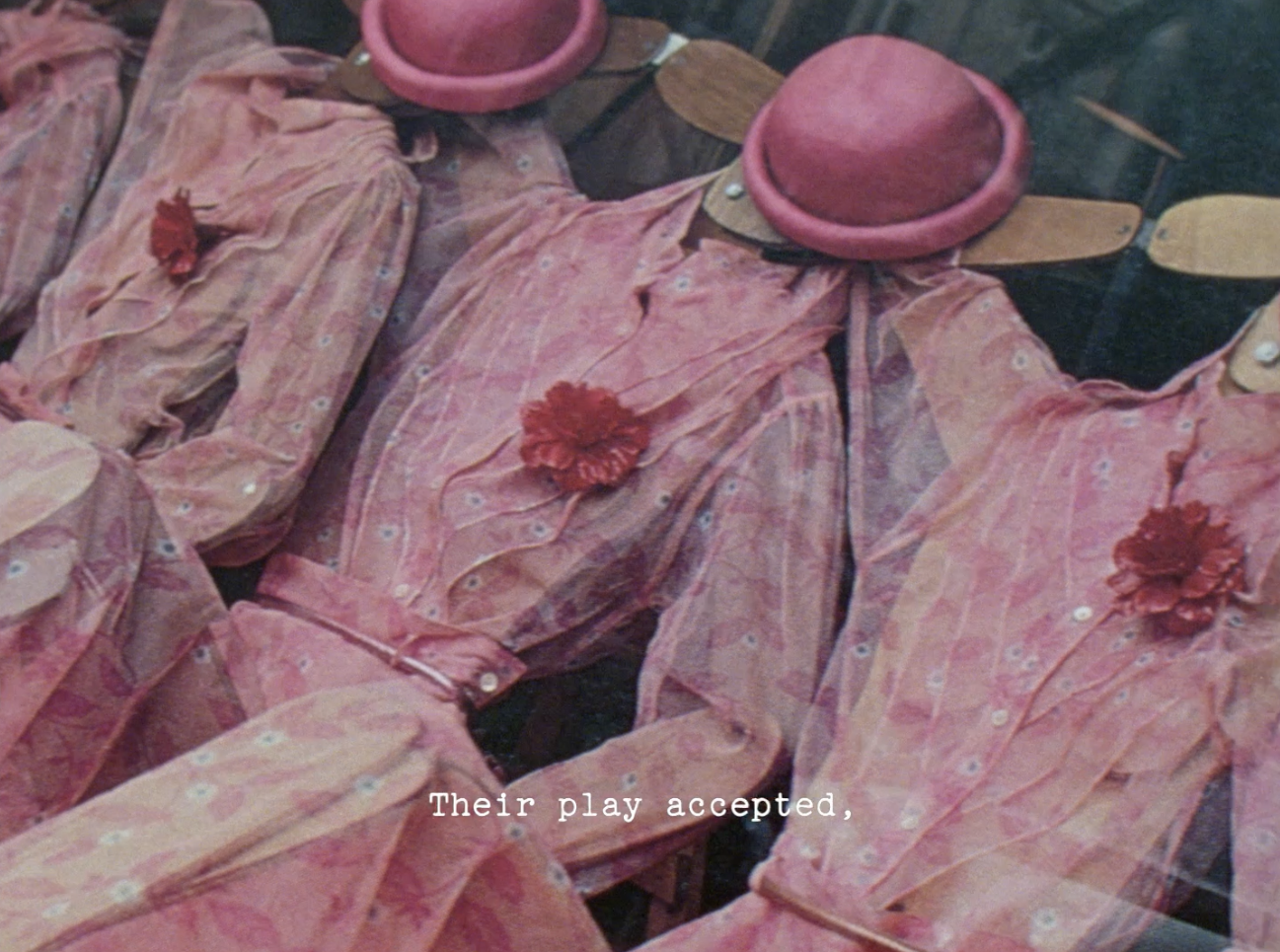
You would see a geography made of things. You would be outside and inside at the same time. You would see Paris at night and shop windows showing perfect interiors through a replication of imperfect exteriors.(13) You would read – antique dealers, bookshops, record shops, restaurant menus, travel agencies, shirt-makers, tailors, cheese-shops, bootmakers, confectioners, delicatessens, stationers – From Palais-Royal to Saint-Germain-des-Pres, from Champ-de-Mars to the Champs-Elysees, from the Luxemberg Gardens to Montparnasse, from Ile St Louis to the Marais, from Place des Ternes to Place de l’Opera, from Madelaine to the Monceau Gardens.(14) You would see the city as a list – a list of things to do, a list of things to see. A list of fashionable items alongside a list of items that were not. You would see Paris as a list of things to procure, to consume, to pass by.
You would see a world in the process of change, transformation, flux. You would see a world that has always been the same. You would read: They would have gone on a cruise and, on their return would have found a flat miraculously enlarged, transformed, converted, refurbished, a model apartment, full of custom-built details, removable partitions, an efficient and unobtrusive heating system, invisible electrical wiring, good quality furniture. You would see a world that had changed inside and out. Inside buildings, inside films, inside books, advertisements and magazines. Inside peoples’ minds. You would see a world formed from interiors (a new idea). Rugs, sofas, cushions, lights. You would see spaces vacated by the internal lives of Jerome and Sylvie, of anyone, replaced by an exterior display of not who they were but what they wanted to be. You would see a gold watch. You would see gold watches. You would see a screen gone dark. You would read: They would have liked to be rich. You would see an image of a window display of the Galerie Germaine. You would read: They would have liked to be rich. You would see bands of light in the glass. You would read: They believed they would have been up to it.
You would see the cover of a 1970s edition of Connaissance des Arts photographed on top of an exquisite fabric, priceless cloth.(15) You would read: Thus did they dream, stupidly, happily, of inheritances, jackpots, winning at the races. You would see the kaleidoscope of a boutique window filled with shoes and reflections. You would see young people rummaging through objects at a flea market in Paris, 1970.(16) You would read: Then in gusts other mirages swirled.
You would see scenes from Un Homme Qui Dort (A Man Asleep).(17) You would have once before seen A Man Asleep in English. You would recall the voice of Shelley Duval. You would read somewhere that when the film first appeared in London it was mistitled The Man Who Dreams.(18) You would wonder how many people would go to see a film that would only be real for a brief time before it disappeared. Before the film would reappear and be called something else.
You would find your copy of Things by Georges Perec. You would go to the chapter on cinema which comes after the chapter on food. You would read: Above all they had the cinema. And this was probably the only area where they had learned everything from their own sensibilities. They owed nothing to models. Their age and education made the members of that first generation for which the cinema was not so much an art as simply a given fact; they had always known cinema not as a fledgling art form, but from their earliest acquaintance, as a domain having its own masterworks and its own mythology. Sometimes it seemed as if they had grown up with it, and that they understood it better than anyone before them had ever been able to understand it.(19)
You would not see a remake of Things, by Jean Mailland, Raymond Bellour and Georges Perec – the script Perec wrote in 1966 would remain unrealised.(20) You would not see Sylve and Jerome. You would not see characters. You would not see sets. You would not see a story or narrative. You would not see things that were seen and not seen by an audience in 1970, by television audiences everywhere. You would not see Michel Foucault or Noam Chomsky.
You would hear the voice of Foucault. You would hear the music of Klaus Schulze. You would see material taken from an archive of fashion publications. You would see sequences from Shutterstock used under license. Used as something else. You would see closeups of fashion magazines, lifestyle magazines, advertisements made in Paris before you were born. You would see a fabricated world, the fashioning of space. Quite literally a space fashioned from desire, a space fashioned from reproductions, a space fashioned from objects to be longed for and hence to be made real. You would see a plastic-mounted 35mm slide. You would see two anonymous, unnamed members of a TV audience from 1970. You would see high resolution playback.(21) You would see high resolution attractions. You would see high resolution appearances. You would see high resolution. You would see fascination. You would be fascinated.
You would see a remake of a film that would never be made.
© Duncan White 2026