
Ellen Ystehede
My Job Is to Be Judgemental
Sentimental Value costume designer discusses her design philosophy, her fascination with cultural studies and what it means to ‘nail’ a character.
By Marketa Uhlirova
17 June 2026
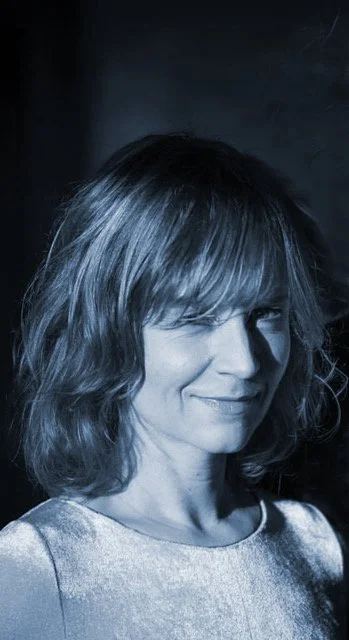
Norwegian costume designer Ellen Ystehede is best known for her long-standing collaboration with director Joachim Trier, including the feature films Oslo, August 31st (2011), Thelma (2017), The Worst Person in the World (2021) and, most recently, Sentimental Value (2025). Spanning costume design for cinema, theatre, television, and commercial film since 2004, Ystehede’s work is rooted in understated realism, shaped by a close observation of everyday dress practices. She has designed costumes for contemporary films across different genres, from horror (Babycall, 2010) to comedy (Welcome to Norway, 2016), adventure (Operation Arctic, 2014), and drama (Hope, 2019), as well as the crime TV series Lilyhammer (2012–2014).
Marketa Uhlirova spoke to the costume designer about her approach to creating characters, the differences between designing for stage and screen, and the craft of sourcing clothing and shaping looks that feel precise and true. The interview focuses primarily on Ystehede’s work on Sentimental Value. It has been edited for length and clarity.
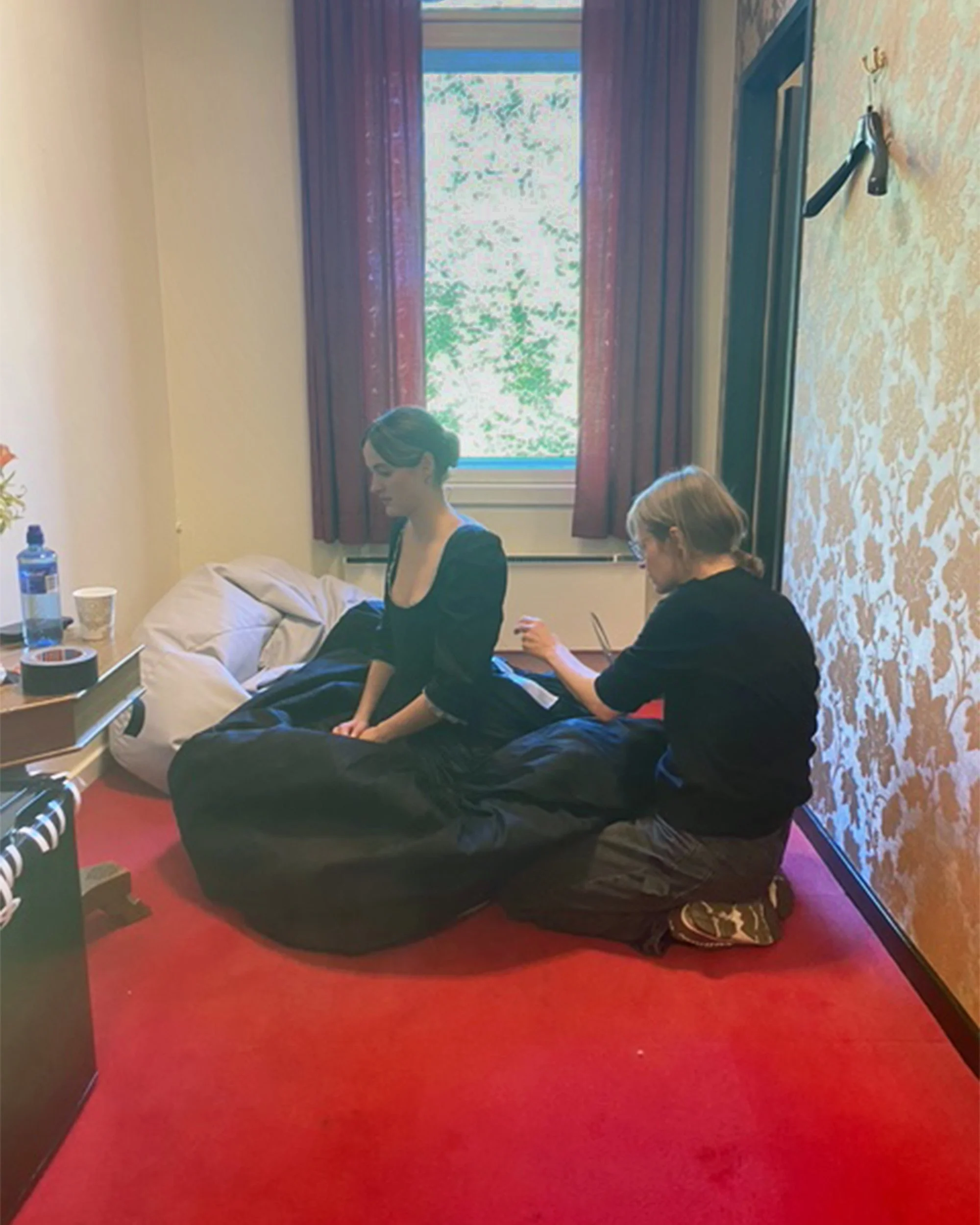
Behind the scenes at the National Theatre in Oslo (photo by Clara Heinius)ON AWARDS
Congratulations on the Oscar for Sentimental Value, but also on the nine nominations altogether.
It has been a strange few months. The year started off quiet, with the film industry being a little slow. I was doing commercials, which can be great fun. But then we’ve had the awards season, which has been quite a ride for our film. Many of the crew who worked on Sentimental Value were invited to the BAFTAs – both the pre- and post-events – and then the Oscars. Joachim [Trier] involves us all. Some of us went to the European awards, and in the USA we were a big Oscars Sentimental gang. We stayed in LA for about five days and went to the ceremony where we won the Best International Feature. It was very interesting and it’s fantastic that people really seemed to like the film. Now it’s back to reality, even if Sentimental Value still feels like a fairytale.
Speaking of the Oscars, do you think the kind of costume design you do gets the recognition it deserves at award level? I ask because the sort of costume design that is awarded is usually where design and artistry are very much on display. Yours is much quieter and you don’t make all your garments from scratch. How do you feel about this?
I think it’s fair that awards are given for outstanding craft. The work of all the nominees is worthy and truly impressive – which is not to say that it’s quick or easy to find the right contemporary jacket in store. The search for the perfect jacket can sometimes take as much time as it does to sew an 18th-century dress from scratch. But of course, it’s a bigger job to create an entirely different time or universe. The route to the final result can be easy or hard, but the final image must be right. As costume designers for film, we all essentially do the same thing: we try to make characters work for the story, we make them believable, so they are ‘just right’. For us it’s all about style, silhouette, textures and colours, and how to make a great image. But there are different genres within this art form. With films like Sentimental Value, I am certainly doing something very different from, say, Frankenstein. Typically, the point in my work is that you can’t see that I’ve done a job, that the characters are dressed by me. That’s not to say you can’t twist this and have a contemporary look that’s larger than life and where you get to make your own universe. But that is not necessarily right for many of the films I have worked on.
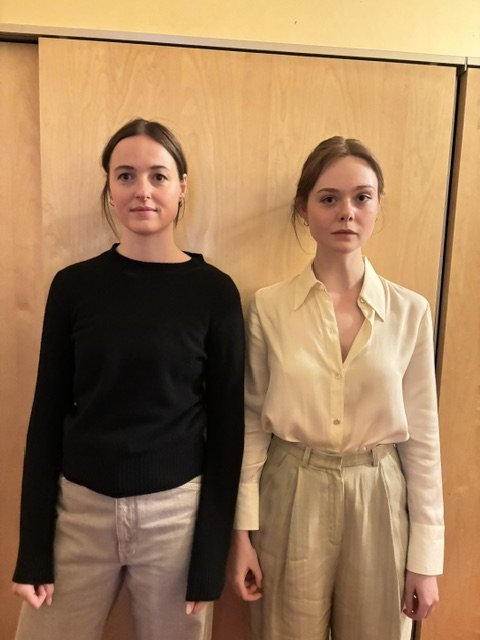
Renate Reinsve and Elle Fanning in costume at the National Theatre (photo Ellen Ystehede)ON STAGE VERSUS SCREEN
A very early scene in Sentimental Value shows the stage actress Nora (Renate Reinsve) in a moment of agony before going on stage. She seems to be having a panic attack and, at one point, rips into her costume to be able to breathe. I think it’s a great example of how costume can take on some of the drama in a scene – something important happens through it. I bring this up because I know you trained in theatrical costume and set design and you have also done a number of productions for the theatre. Is there a big difference in dressing actors for the stage versus the screen?
The scene was interesting for me too because it gives you a glimpse of how the costume department works backstage when something has gone wrong. Whether there is a major difference between the stage and screen depends on the play, and there are different ways of working in both. In theatre, you are more aware of what the final piece is going to be. You can participate in the lighting rehearsals, and you can see quite clearly what the final result will look like from beginning to end. Still, everything only really comes together quite close to the premiere, so you do need a solid plan with great visual sketches and models.
Films are almost always shot in pieces for various technical and practical reasons. With film, you work in a kind of reverse order: you shoot different scenes, you do a lot of takes. It’s like a puzzle, or like those drawings we made as children, where each person draws a different body part on a folded piece of paper that is passed around, so you only see the result at the end. And it’s always a surprise. Of course, you can see things through a monitor on the set, but you can’t be there all the time. You don’t have complete oversight. So many things can happen during shooting, editing, and post-production: scenes get cut, or a dress you so carefully sourced may only be seen in the dark…
In theatre, you normally have more access to technical staff, including seamstresses. This is not so much the case in film, although it depends on the production. Nora’s dress, which you mentioned, was made by a freelance seamstress. We actually needed to make three dresses – two bustiers and three skirts – to sustain us through all the back and forth. We also made a version in white, which only gets about a second of screen time. And we did some technical drawings of where to rip the dress and exactly how to do it. The repair that you see in the scene needed to be done in one go, so we had to choreograph how to do it quickly and how to do it right. This situation illustrates one of the differences between the two art forms: you can get away with this kind of quick fix in the theatre, but in film, it wouldn’t work because there you see everything up close, often from all angles.
You have to think differently about the two. There are certain practical considerations, like care and maintenance, which are more intense in theatre, where a costume must last through repeated performances – it often lasts longer than those in film production. Another issue is sound. We hide microphones near the actor’s neckline so the costume’s fabric doesn’t sound crinkly. Sound departments hate clothes made from Gore-Tex! By the way, I love the sound when Nora rips the fabric.
All the fascinating secrets of the trade… Did your training in costume and set design give you any particular insights that you draw on to this day?
Perhaps this one: you can design whatever you like, but once it’s in the frame, there will be surprises, and it doesn’t matter whether the frame is a stage or screen. You are ultimately searching for an image within a frame. Everything has to come together as a whole. Costume design is about being aware of everything around you and trying to figure out what you actually want to show.
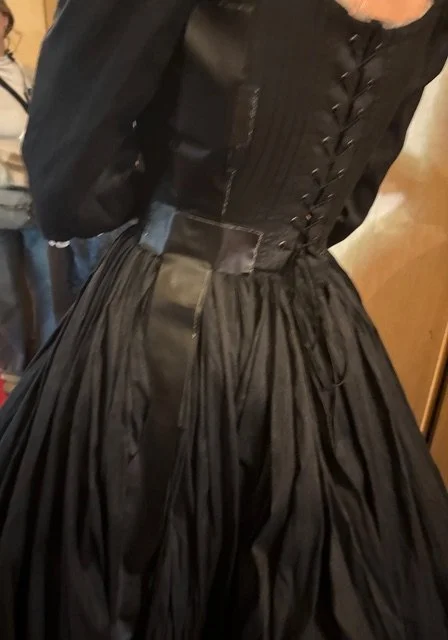
Nora's black dress (photo Ellen Ystehede)ON NAILING
A CHARACTER
In our previous conversations you’ve often talked about ‘nailing’ characters and described the search for a character as almost an obsession. Can you say more about that?
To ‘nail’ a character means to create someone believable, whose appearance feels right. It’s a very intuitive process. We even tested the AI algorithm in Sentimental Value, just for fun. We gave it a very precise description of the gold dress Rachel (Elle Fanning) wears on the beach in Deauville, and it got it completely wrong – it’s hard to explain exactly how, but it just did. For me, dressing a character is about getting to understand them: why they dress the way they do and why they behave as they do. To use the sisters Agnes and Nora as examples, I wanted Nora to look more styled and more deliberate in her clothing choices. She has more exclusive pieces, changes her clothes more often, and although she is supposed to be a cool, carefree person, she cares a great deal. By contrast, I wanted Agnes to seem less concerned with her appearance. Not because she doesn’t care, but because she has less time to pay attention to it. Her clothes are a little blander, her sweaters are more worn and they have a bit of pilling. The problem was that Inga (Ibsdotter Lilleaas) looked great in everything we put on her, including cheap fabrics like acrylics. Maybe I could have pushed the contrast more, but in this film it seemed right to tone things down.
You are known for a cool, understated Scandi-chic aesthetic, but within that there are still myriad nuances, based on careful observation. Would it be a stretch to say your practice comes close to ethnography?
My practice is a mix of design, aesthetics and cultural studies. At college – I went to Central Saint Martins in London – I loved cultural studies. I have always been interested in perceptions, in what is seen as pretty or ugly, and why. I often ask myself why I see things the way I do; why do I appreciate this and not that? Why is one year all about baggy trousers and why does this become awful the next year? I have actually started a course in social anthropology twice, but each time ended up working on a film instead. I have attended a course in aesthetics, which explored the idea of ugliness, and I found it fascinating. I’d love to do a film where everything is just ugly because, again, what is ugly? I’d like to build a coherent style that I find completely disgraceful! And isn’t that how new trends start, with the ugliest thing you can think of? That said, I can also be overwhelmed by beauty – the sheer pleasure of a perfectly right shade of green, or a fabric that is just right.
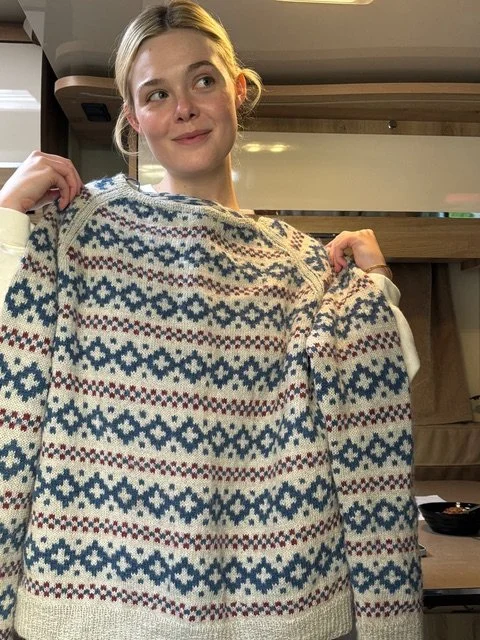
Costume pre-fitting of a Norwegian sweater worn by Elle Fanning's Rachel (photo Ellen Ystehede)ON WHAT
A COSTUME DESIGNER DOES
How do you see the role of the costume designer?
My job is to help the director tell the story and create their world. You can dress someone to make them almost invisible or, on the contrary, very visible. Joachim and I know each other well and we have a lot in common; we know many of the same people, so it’s perhaps easier for him to explain to me the kind of characters he is looking for. He generally doesn’t talk about characters in terms of how they dress; it’s more about what they do, what sort of music they listen to and where they hang out. I try to locate them socially and get into their heads, and imagine how they want to come across, but also how they feel in their clothes. The way something fits, or the way socks sit, can affect how you feel. Bad underwear can mess up your day. I am especially concerned with trousers. It’s not just about how they look, but how they actually feel when you wear them. Ideally, I like to give actors the costumes early enough so they can break them in and test them properly, not just during a fitting. Costumes change once they are worn, and you need to see how they look after a few scenes or a few days. Costume design is a process of trying things out, understanding what directors want, and figuring out how to bring that to life.
You inhabit a form of knowledge that is specialist and accumulated – obviously – but it’s also very much embodied. It’s intuitive and felt in the gut, almost viscerally. Is taste at the heart of it?
As you can see, my job is to be judgmental. I need to be able to tell you how someone is from the first impression: where they are from, what they like doing, and what perspective they have on life. I have to judge a book by its cover, but just as importantly, I also need to allow for that to be wrong, because the way we are and the way we express ourselves go beyond the first impression. You need to try, as best you can, not to be too narrow-minded and I keep reminding myself not to always see things from my own angle.
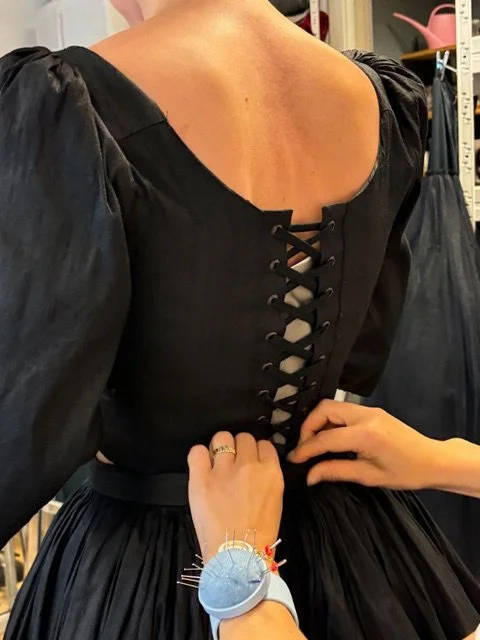
Costume fitting: seamstress Karine Naess adjusting Nora’s theatre dress (photo Ellen Ystehede)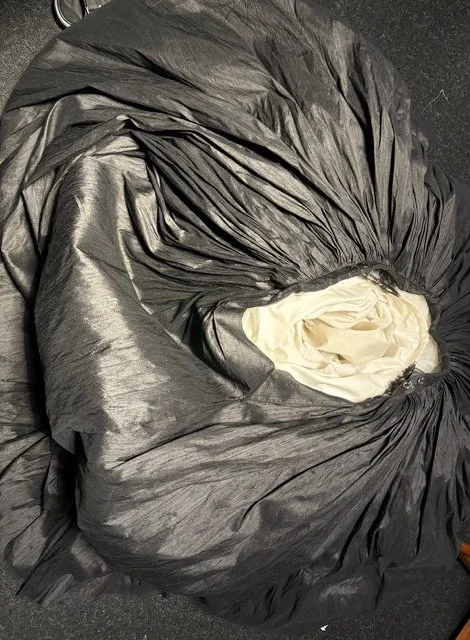
Nora's black dress with lining on show (photo Ellen Ystehede)You have worked with Joachim Trier on three other films – Oslo 31. August (2011), Thelma (2017) and The Worst Person in the World (2021). But you have longer-term relationships with other directors too…
I enjoy working with many different directors, whether on long-term collaborations or one-off projects. I had a great experience on Hisham Zaman’s A Happy Day (2023). It was a small independent film shot in the far north of Norway, at a camp for immigrants. The production had a strict colour palette they asked me to follow – the clothes could come from anywhere, but they had to fit that palette. I tried to find things that did and didn’t fit in. My process involves a lot of research. I look at people around me an awful lot. I search on Instagram, documentary footage, film, the news – probably more so than film, in fact – and magazines. I try to see how people actually dress: how they do or don’t iron, how they wear t-shirts with crease lines, how they mismatch, how clothes don’t fit, and the dated styles people hang onto. There is so much to take in, and everything is constantly changing. I recently worked on four episodes of the Netflix drama A Better Man (Thomas Torjussen, 2025) about an internet troll who goes through an unexpected sartorial transformation.
Do you sketch?
I do, but it would be nice to sketch more and to have the time to make things from scratch, including carefully selecting all the fabrics. On most of my projects, it’s a case of me running around trying to find things on a limited time frame. I sketch mostly for myself, to remember what I have been thinking about. It helps me to understand what I am looking for, although it can sometimes be too abstract for others to understand. Reference images and mood boards can be more precise. A mix of the two is usually ideal, but at the end of the day, you never know how a garment you have sketched will work on the character. Everything has to happen so quickly; you have to try clothes on. That said, for my next project (which I am not allowed to discuss yet), we will be producing a lot of garments, so I will need to sketch a lot more!
What do you have in your studio?
What don’t I have? I keep a lot of ‘backgrounds’ (by which I mean basic costumes for extras and supporting artists, but also for principal cast members) – things that are useful to hold on to because they can be reused, like men’s shoes, jeans, suits. I also keep things I’d love to dye and turn into something new. My studio is partly an archive, in which I can find the right things and make alterations. I’d also love to do more knitting, fabric printing, and weaving. But I don’t always work from my studio. With bigger productions you get a workspace because they require a lot of space.
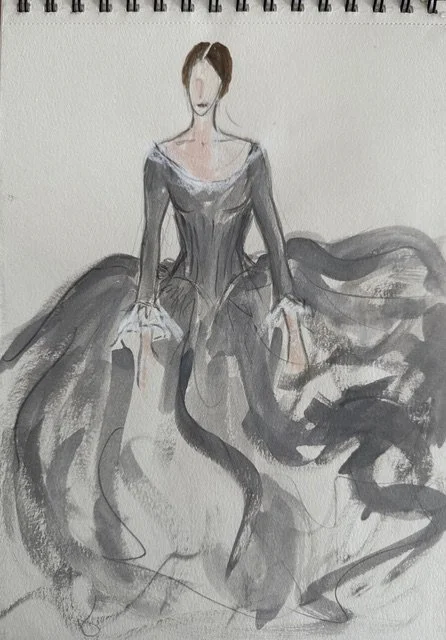
Design sketch for Nora's black dress (courtesy Ellen Ystehede)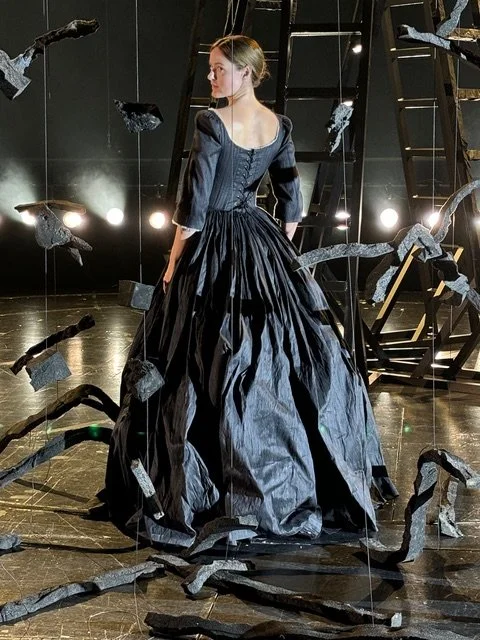
Renate Reinsve on set (photo Ellen Ystehede)Where do you actually source all the clothes for a film?
Through a combination of renting from large and small costume houses, borrowing from other costume designers, and finding things in shops. There is a good costume house in Oslo, two more in Stockholm, and several in Copenhagen, all of which I can access easily. There are also a few smaller ones. The larger houses, like Peris Costumes in Madrid, are very efficient. In Oslo, we also have good second-hand shops, and I buy from high-street shops and online. I borrow some things, and I occasionally make deals with fashion brands. The most frustrating thing is when you know exactly what jacket you want and you know it’s out there somewhere, but you just can’t find it.
Is there overlap between your work in costume design and fashion styling?
Yes, I work across both and they do overlap. But they are also opposites. In commercials and editorial shoots, the aim is to show the clothes. In film you build characters. I have done styling in the past – various commercial jobs that require styling rather than costume design – and I also shoot a lot of commercials. I touched on the overlap with Rachel in Sentimental Value. In fact, I approached her as a stylist would. I wanted her to look as if she’d been sponsored or dressed by a brand. She was meant to feel a little like a paper doll. Saint Laurent and Chanel supplied us with a few wardrobe pieces. There was a fantastic Saint Laurent dress provided especially for her, but we only really see her wearing it in the cinema scene, in the dark! And other scenes were cut. That’s film for you. It’s not about the clothes, let alone product placement – it’s about what serves the film and the character. I promised myself I’d stick to that way of thinking, even when the clothes are wonderful and lent to us for free.
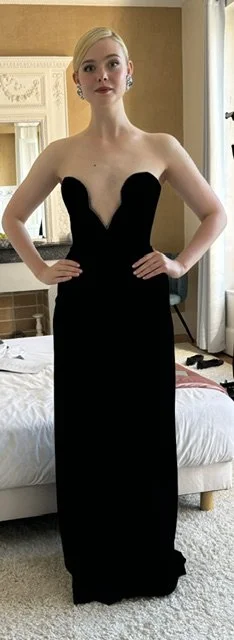
A black velvet Saint Laurent dress
for Elle Fanning's character Rachel
(photo Ellen Ystehede)
Cover image Pål Dybwik